


Financial Mistakes Bahamians Make: 7 Deadly Money Traps Keeping Good People Poor (The Shocking Truth About Your "Safe" Savings)
Financial mistakes Bahamians make are costing families hundreds of thousands of dollars in lifetime wealth—and most people have no idea it’s happening.
Margaret thought she was doing everything right. For twenty-three years, she dutifully saved $400 monthly in her “high-yield” savings account. By 2020, she had $127,000 and felt financially secure. Then her nephew asked a devastating question: “Do you know how much purchasing power you’ve lost?”
The answer made her sick. Due to inflation, her $127,000 now bought what only $87,000 would have purchased when she started saving. She had lost $40,000 in purchasing power by following the most sacred rule of personal finance.
Margaret’s story isn’t unique. Across the Bahamas, hardworking families are unknowingly destroying their wealth through seven deadly financial mistakes that seem responsible but are actually financial poison.
The Hidden Wealth Destroyers
Most Bahamians believe they’re making smart money moves when they’re actually guaranteeing poverty. These mistakes compound over decades, creating the difference between families who build generational wealth and those who struggle paycheck to paycheck.
Here are the seven deadly financial mistakes keeping good Bahamians poor:
Mistake #1: Treating Savings Accounts as “Safe” Investments
The mathematics are terrifying. The average Bahamian savings account earns 0.5-1% annually while real inflation runs 3-6%. This means every dollar loses 2-5% of purchasing power yearly.
Consider James, who saved $25,000 over five years. His account grew to $25,628 with interest, but inflation reduced its purchasing power to $19,000. He lost $6,000 by being “financially responsible.”
Meanwhile, that same $25,000 invested in diversified stocks averaging 7% annual returns would have grown to $35,100 in real purchasing power. The “risky” investment protected wealth while the “safe” account destroyed it.
Mistake #2: Believing Your House is Building Wealth
Michael spent twelve years making mortgage payments, thinking he was building equity and wealth. After Hurricane Dorian disrupted his income, he discovered the brutal truth: his house was actually consuming wealth, not creating it.
Monthly expenses totaled $1,900: mortgage, insurance, taxes, maintenance, and utilities. His house generated zero income. By definition, this made it a liability, not an asset.
The real cost? Over twelve years, Michael’s total housing investment exceeded $318,000, while his house was worth only $220,000. He lost nearly $100,000 by following conventional “homeownership builds wealth” advice.
Mistake #3: Trading Time for Money Instead of Building Systems
Jennifer worked 50-hour weeks as an office manager, earning $32,000 annually and living paycheck to paycheck. She faced the mathematical reality that devastates most workers: you can only sell 2,000 hours per year.
The transformation came when Jennifer learned to build leveraged income. She created digital courses about Caribbean home organization that sold automatically while she slept. Last month, she earned $394 overnight from two course sales—more than most Bahamians make in a full day.
Jennifer discovered that time is your most valuable asset, and trading it for money is the fastest path to permanent financial limitation.
Mistake #4: Depending on Single Income Sources
Sandra climbed the corporate banking ladder for eight years, reaching senior management with a six-figure salary. She felt financially bulletproof until COVID-19 eliminated her entire department overnight.
Because Sandra had never developed alternative income streams, she went from managing millions in corporate assets to borrowing money for basic expenses within six months. Her “secure” position was actually the ultimate financial risk.
The mathematics are clear: depending on one employer, in one industry, for 100% of your income creates a single point of failure that guarantees eventual catastrophe.
Mistake #5: Following Money Advice That Worked for Previous Generations
Your parents could raise families on single incomes because economic rules were different. In 1960, a dollar had the purchasing power of roughly $9 today. Wages and inflation moved together. Bank interest often exceeded inflation.
That world ended in the 1980s. Today’s financial landscape punishes savers and rewards asset builders. The advice that created middle-class stability for your parents now guarantees financial struggle for your generation.
Working harder, saving more, and avoiding all debt—the pillars of previous generations’ financial success—are now recipes for relative poverty.
Mistake #6: Operating from Scarcity Instead of Abundance Mindset
Patricia and Sharon grew up in the same Nassau neighborhood with identical opportunities. Today, Patricia struggles with two part-time jobs while Sharon owns three rental properties and plans early retirement.
The difference wasn’t education, intelligence, or luck. Patricia learned scarcity thinking: “Money is hard to come by,” “People like us don’t get wealthy,” “Opportunities are rare.”
Sharon developed abundance thinking: “Money flows to those who create value,” “Success is learnable,” “Opportunities are everywhere for those who look.”
These different mindsets created self-fulfilling prophecies that shaped every financial decision over 25 years.
Mistake #7: Not Programming Children for Financial Success
Eight-year-old Sophia asked her mother about a luxury car. Her mother replied, “Some people are just luckier than others. We should be grateful for what we have.”
In that moment, she programmed Sophia with beliefs that guarantee financial limitation: wealth is luck-based, their family doesn’t deserve nice things, wanting more is ungrateful.
Three blocks away, another eight-year-old asked the same question. His father responded, “That person probably built a business that helps lots of people. When you solve big problems, people pay you well. What problems could you solve?”
Ten years from now, these children will have completely different relationships with money, opportunity, and their own potential.
The Compound Cost of Financial Ignorance
These mistakes don’t just cost money—they compound over generations. Families unknowingly pass financial limitations to their children, who pass them to their children, creating cycles of struggle that seem impossible to break.
The mathematical impact is staggering. A family making these seven mistakes for 30 years could lose over $1 million in potential wealth compared to those who understand modern money principles.
Breaking the Cycle
The solution isn’t working harder or earning more—it’s understanding how money actually works in today’s economy. It’s learning to build assets instead of collecting liabilities, creating systems instead of trading time, and programming abundance instead of scarcity.
Every day these mistakes continue costs you compound growth you’ll never recover. Every month you wait to learn modern wealth-building strategies is a month of financial freedom lost forever.
The principles that create wealth haven’t changed, but the methods have evolved dramatically. Those who understand the new rules are building wealth faster than any generation in history. Those who don’t are falling further behind every year.
Your financial transformation starts with understanding these deadly mistakes and implementing the proven strategies that create lasting wealth. The choice between generational poverty and generational prosperity is yours—but only if you make it before these compound costs become irreversible.
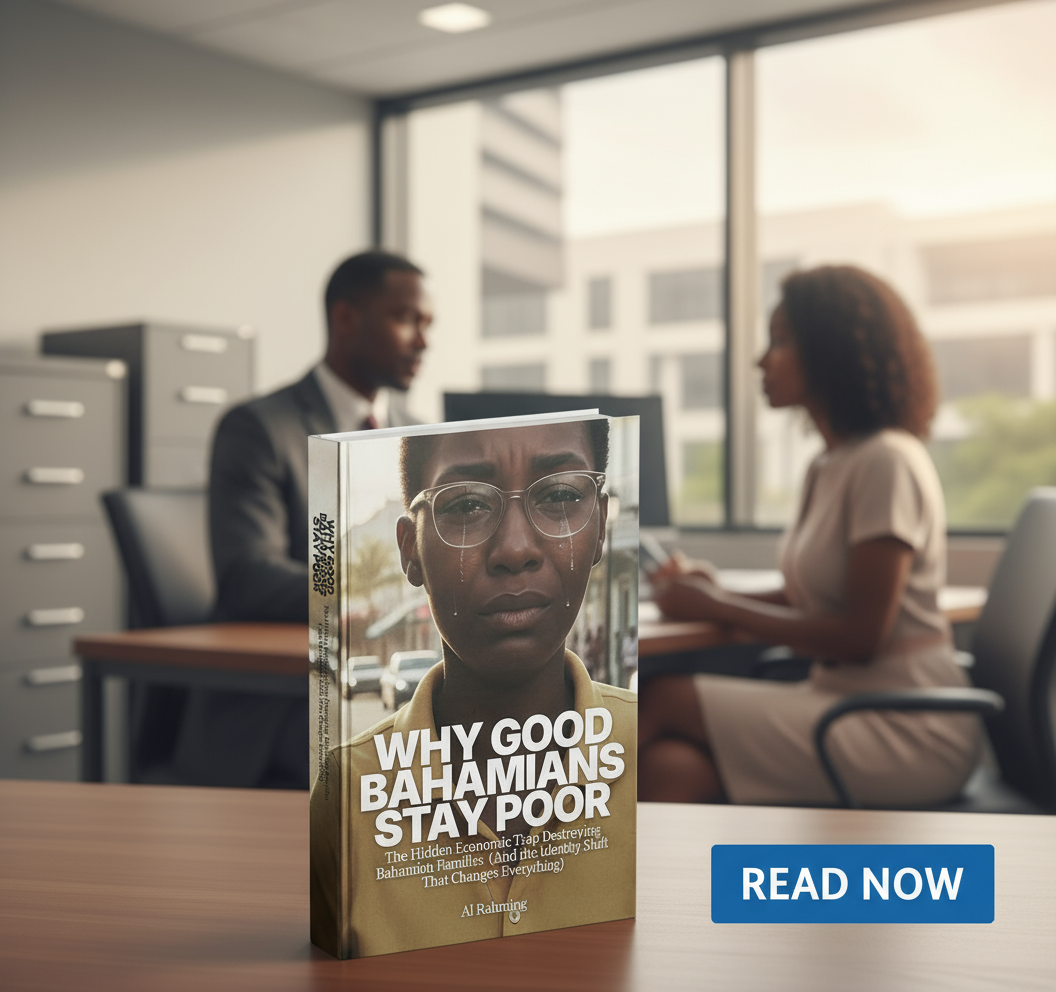
Ready to break free from these wealth-destroying patterns? Discover the complete financial awakening system that’s transforming Bahamian families from struggle to success. Get “Why Good Bahamians Stay Poor” now and start building the wealth your family deserves.