

Marcus thought he was making smart financial decisions. Government job, steady paycheck, money in the bank. He followed every piece of advice his parents gave him about building security in the Bahamas.
Then he calculated what his “safe” savings had actually cost him over five years.
The number made him physically sick. His $25,000 in savings now bought what $19,000 would have purchased in 2020. He had lost $6,000 of purchasing power by following the most sacred rule of personal finance his family taught him.
While Marcus was being “financially responsible,” his neighbor Janet quietly built a six-figure online business from her dining room table. She started with $200 and a laptop. No special connections. No family money. Just a different understanding of how money actually works in 2025.
The difference between Marcus and Janet wasn’t intelligence, work ethic, or luck. It was something far more fundamental—and far more fixable.
Janet understood that wealth is created in your mind before it ever appears in your bank account. Marcus was still using financial strategies designed for an economy that no longer exists.
Right now, thousands of smart Bahamian professionals are making the same seven mistakes that guarantee they’ll stay poor while watching others get rich. These aren’t obvious mistakes like overspending or failing to budget. These are the “responsible” financial decisions that have become economic poison in today’s world.
The Economic Hurricane Destroying Bahamian Families
Let me share something that might make you uncomfortable. The financial advice your parents gave you—advice that worked for them—has become guaranteed path to poverty in today’s economy.
Maria discovered this the hard way. Sitting at her kitchen table in Nassau, staring at a grocery receipt that shattered her world. $247 for what used to cost $130 just three years ago. Same groceries. Same store. But her government paycheck? Still the same.
She did the terrible math that millions of Bahamians are doing right now: at this rate, her family would be priced out of basic living within five years. Not luxuries. Not vacations. Food and shelter. The basics.
Maria followed every traditional money rule:
- Work hard at steady job ✓
- Save money in the bank ✓
- Buy a house ✓
- Live below your means ✓
- Stay out of debt ✓
And she’s still drowning.
Here’s what nobody wants to tell you: Your financial struggles aren’t a personal failing. They’re the predictable result of using obsolete strategies in a transformed economy. While you’ve been following the “safe” path, the entire economic game has changed around you.
The 7 Dangerous Mistakes Keeping Good Bahamians Poor
Mistake #1: The Single Income Trap
Smart professionals believe having a “secure” government job or steady position protects them. This is actually the riskiest financial position possible in today’s economy.
Why this destroys wealth: You’re creating a single point of failure for your entire family’s financial security. When that income stops—whether through layoffs, economic crisis, or health issues—you have zero alternatives.
The psychological trap: We judge “financial responsibility” by appearance, not results. Having one stable job looks responsible to others, so we cling to this strategy even as it guarantees poverty.
What wealthy Bahamians do instead: They build multiple income streams that don’t depend on their time. Even if they have primary employment, they create additional revenue sources through online businesses, investments, or intellectual property.
Mistake #2: The Cash Hoarding Death Spiral
“Save your money in the bank.” This advice is financial suicide in 2025.
The brutal math: With Bahamian inflation running above bank savings rates, every dollar sitting in your “safe” account loses purchasing power monthly. You’re guaranteed to become poorer by being “financially responsible.”
The fear-based decision: People are so afraid of losing money that they guarantee they’ll lose money. They choose the certain loss of inflation over the uncertain possibility of investment risk.
What this costs you: A Bahamian family keeping $50,000 in savings loses approximately $3,000-5,000 in purchasing power annually. Over 10 years, that’s $30,000-50,000 of wealth destroyed by “playing it safe.”
Mistake #3: The Consumer-Only Mindset
Most Bahamians spend their entire lives buying products and services but never creating them. They’re always on the expense side of someone else’s business equation, never on the income side.
The psychological reality: People don’t know themselves as well as they think. They believe they’re “not business types” or “don’t have anything valuable to offer”—but this is usually fear disguised as self-knowledge.
The global opportunity they’re missing: The internet gives you access to 1.5 billion English-speaking customers. Your Bahamian perspective is unique and valuable globally, but only if you shift from consumer to creator.
Real example: Marcus went from struggling fishing guide to six-figure marine education business by teaching his knowledge online. His unique Bahamian expertise became his competitive advantage in the global market.
Mistake #4: The Location Limitation Delusion
“The Bahamas is too small for real business opportunities.” This belief keeps smart people trapped in artificial scarcity while the world’s markets are literally at their fingertips.
The self-deception: People rationalize their lack of action by blaming external circumstances they can’t control, rather than acknowledging internal limitations they can change.
The reality inversion: Small size creates agility advantages. Hurricane experience builds mental toughness. Service culture provides natural customer experience skills. You’re trying to overcome advantages others wish they had.
Mistake #5: The “Good Person” Poverty Programming
Caribbean culture sometimes treats wealth-building with suspicion. “Money isn’t everything.” “Don’t be greedy.” “Be grateful for what you have.” This creates internal resistance to financial success.
The belonging trap: People prefer fitting in with struggling peers over standing out through success. They’d rather be right about money being unimportant than risk looking different from their social group.
The moral confusion: There’s nothing moral about allowing your family to struggle financially when you have the ability to change your situation. Financial struggle doesn’t make you virtuous—it makes you unable to help others.
Mistake #6: The Time-for-Money Prison
Trading hours for dollars creates an income ceiling you can’t break. Whether you’re making $20/hour or $200/hour, you’re still trapped in linear exchange with limited earning potential.
The emotional driver: Fear of uncertainty makes people choose the predictable prison of employment over the uncertain freedom of ownership. They know exactly how much they’ll make next month—and exactly how little they’ll have left over.
The compound cost: Every year you delay building asset-based income is a year of compound earning power lost forever. Time becomes your enemy instead of your ally.
Mistake #7: The Investment Ignorance
Most Bahamians don’t understand how to make their money work harder than they do. They either avoid investing completely (due to fear) or make random investment choices (due to ignorance).
The authority bias: People assume investment knowledge is too complex for “regular people” to understand. They defer to “experts” who often profit more from managing their money than growing it.
The opportunity cost: While their money sits in savings losing purchasing power, global markets have created wealth for those who understand basic investment principles.
The Million-Dollar Mindset Shift That Changes Everything
Here’s the psychological transformation that separates wealth builders from everyone else. It’s not about having money—it’s about understanding how money actually works.
Poor people think: Have → Do → Be
“When I have enough money, I’ll do the things successful people do, and then I’ll be wealthy.”
Wealthy people think: Be → Do → Have
“I’ll be the type of person who builds wealth, do what wealthy people do, and then I’ll have the results they get.”
This isn’t motivational fluff. This is practical psychology. When you change your identity before changing your circumstances, your actions automatically align with your new identity.
Janet didn’t wait until she had money to start thinking like an entrepreneur. She started thinking like an entrepreneur, made entrepreneurial decisions, and entrepreneurial results followed.
Marcus didn’t wait until he was successful to act like someone who creates value globally. He started creating value globally, and global success followed.
The Creator Economy Advantage: Your Bahamian Wealth-Building Opportunity
While traditional employment becomes more insecure, the creator economy has opened income opportunities that didn’t exist five years ago. Bahamians have natural advantages in this new economy:
Cultural assets that create business value:
- Natural hospitality and service excellence
- Storytelling tradition and authentic communication
- Resilience and problem-solving ability from island living
- Unique perspective that can’t be replicated
Real income potential: Bahamian creators are building businesses generating $5,000-$50,000+ monthly by monetizing their knowledge and expertise globally. These aren’t outliers—they’re examples of what becomes possible when you understand the new economic rules.
Your competitive advantage: While you’re worried about the small local market, entrepreneurs worldwide are trying to access the cultural authenticity and unique positioning you already possess.
The Compound Effect of Right Decisions
Every financial decision compounds over time. Make the right decisions now, and they multiply your wealth for decades. Keep making the wrong decisions, and they guarantee poverty regardless of how hard you work.
Marcus discovered this: Instead of keeping money in savings, he invested in building his fishing education platform. Year one: $2,000 profit. Year two: $15,000. Year three: $48,000. Year four: $94,000. Same time investment, exponentially different results.
Janet learned this: Instead of seeking job security, she built business systems that didn’t require her constant presence. Now she earns more in a month than her old government salary paid in six months.
The brutal truth: There is no middle ground. Economic forces reshaping our world don’t care about your comfort zone. You either adapt your financial strategy to modern realities, or modern realities will force adaptation on you.
What Smart Bahamians Are Doing Instead
The Bahamians building wealth in today’s economy share common strategies:
They build multiple income streams that don’t depend entirely on their time or single employer. This creates anti-fragile income that actually gets stronger during economic chaos.
They focus on asset accumulation instead of cash accumulation. They buy things that generate income and appreciate faster than inflation.
They leverage global opportunities while living in paradise. They serve international markets from their Bahamian location, combining lifestyle advantages with income advantages.
They invest in learning wealth-building psychology and practical skills. They understand that knowledge is the ultimate asset because it can’t be taken away and compounds over time.
They start before they feel ready. They don’t wait for perfect knowledge or ideal circumstances. They begin with small actions that build momentum and learning.
Your Financial Awakening Decision
You’re at a crossroads. You can continue following financial advice designed for an economy that no longer exists, or you can adapt to economic reality and position yourself to thrive.
The families who make this shift now will build wealth while others fall behind. The families who delay this shift will watch their purchasing power disappear while wondering what happened.
This isn’t about getting rich quick. This is about developing a relationship with money that protects your family from poverty and positions you to build generational wealth.
This isn’t about taking huge risks. This is about understanding that the “safe” strategies are actually the riskiest ones in today’s economy.
The choice you make about your financial education will echo through your family line for generations.
Option 1: Continue the old patterns
- Follow cultural norms about money that lead to struggle
- Let economic forces control your family’s financial future
- Hope things get better while using strategies that guarantee they won’t
- Risk passing financial limitations to your children
Option 2: Break the cycle
- Learn how wealth is actually built in the modern economy
- Take control of your financial destiny through education and action
- Position yourself to capitalize on global opportunities from the Bahamas
- Create generational wealth through applied knowledge
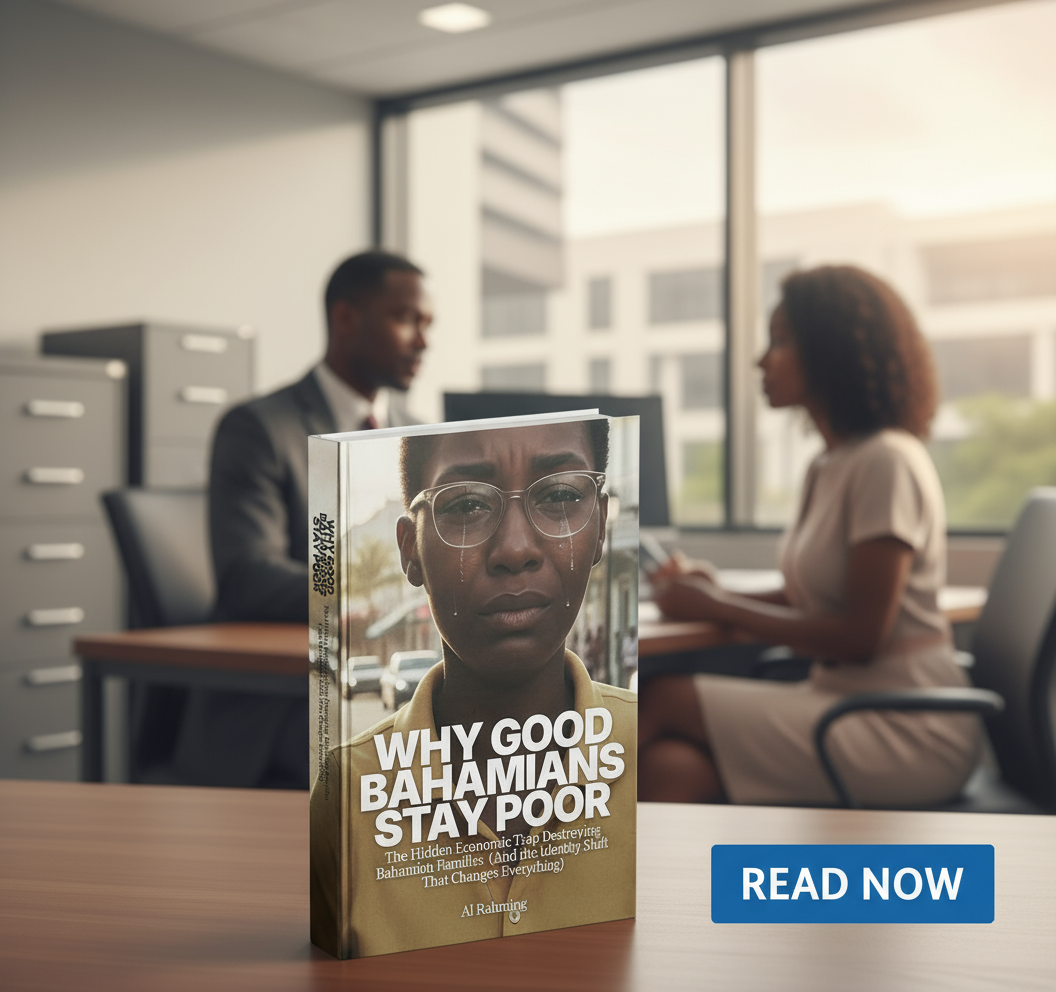
Ready to discover the complete blueprint for building wealth as a modern Bahamian? “Why Good Bahamians Stay Poor” reveals the exact mindset shifts, practical strategies, and step-by-step action plans that are transforming ordinary Bahamian families into wealth builders.
Don’t let another month pass watching your purchasing power disappear while others get ahead. Every day you delay learning these new financial rules is a day of compound opportunity lost forever.
Get your copy of “Why Good Bahamians Stay Poor” and start your financial transformation today →